


Last month, I wrote about how the American Dream is more than a paycheck, and ostensibly non-economic factors like loneliness and civil society breakdown are making it feel out of reach for too many Americans, especially young people. But there’s another force pulling the rug out from under young Americans, and it has everything to do with economics: the federal government and its reckless overspending. Specifically, federal spending on programs for older – and generally wealthier – Americans.
There’s a name for this phenomenon: “Total Boomer Luxury Communism.”
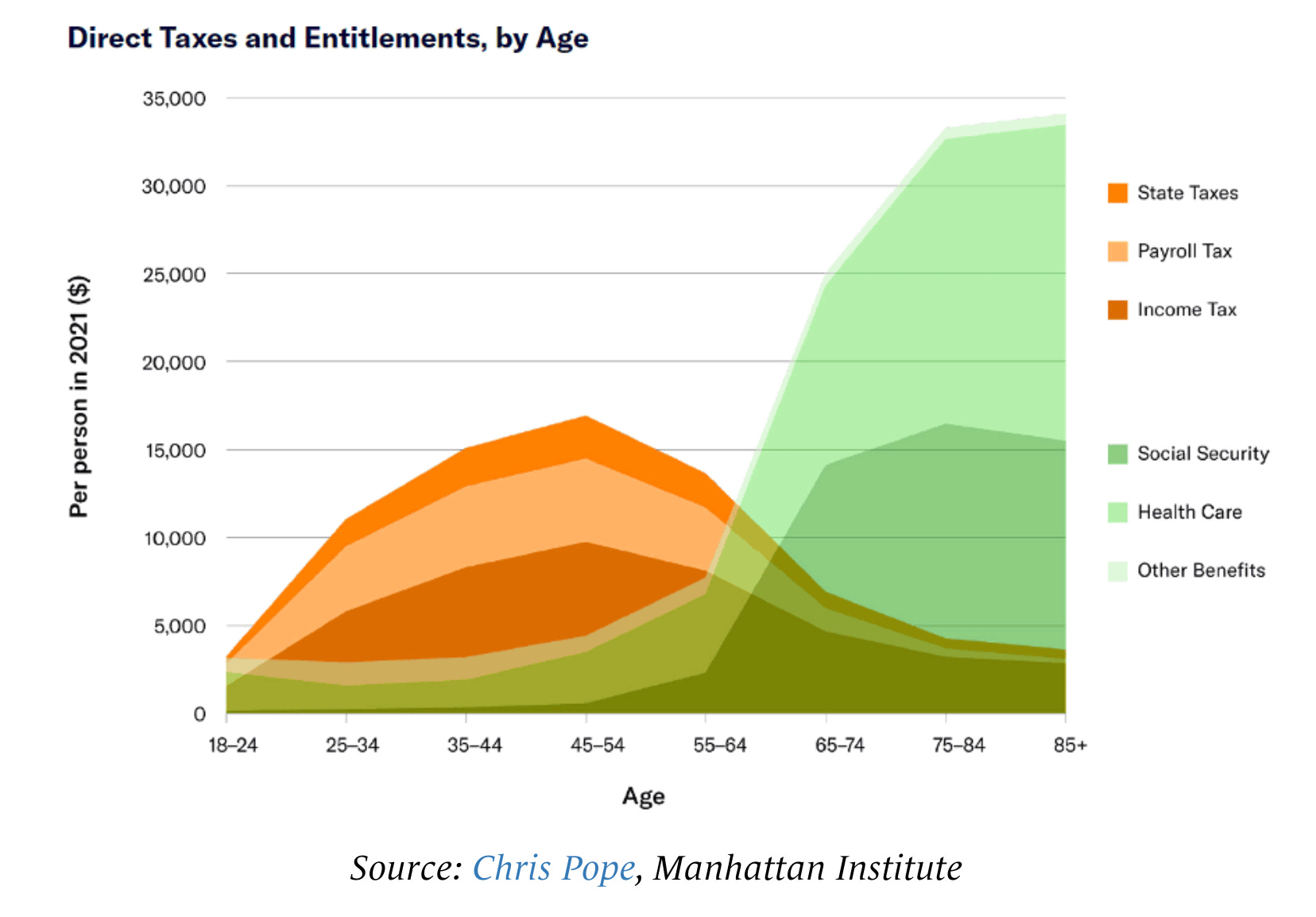
My friend Russell Greene recently coined the term and then helped popularize it in an essay in American Mind, and he’s right to make us uncomfortable: it names a reality too many of our leaders pretend they don’t see: federal spending is heavily skewed toward retirees, who tend to be much wealthier than younger generations.
The mechanics are straightforward and stark. Two programs — Social Security and Medicare — now account for a huge and rising share of the federal ledger. Social Security alone is the single-largest federal program (roughly one-fifth of federal spending), and major health programs including Medicare make up close to one-third of outlays. And they are far from static: the Congressional Budget Office forecasts that rising spending on Social Security, Medicare, and net interest will push federal outlays sharply higher over the coming decade.
Greene writes:
“This generational injustice is compounded at least four times over:
1. Government taxes the young and transfers their wealth to seniors.
2. Government borrows even more to transfer more wealth to seniors.
3. Government debt causes inflation and slows economic growth, eating away at young people’s incomes their entire lives.
4. Government taxes young people again to pay for the debt incurred to pay for senior entitlements.”
To make matters worse, the American people hardly even get a say. So-called “mandatory” spending programs like Social Security and Medicare - and interest payments - which together make up more than three-quarters of all federal spending, are on autopilot, which means they are not voted on annually by Congress.
What does that fiscal trajectory mean in human terms? It means a structural tilt of government policy toward preserving and enhancing current retirement benefits — regardless of cost — while younger Americans shoulder the burden. Greene adds:
“An individual can take in over $60,000 a year from Social Security alone. Meanwhile, Medicare programs are paying for golf balls, greens fees, social club memberships, horseback riding lessons, and pet food.”
This status quo has cascading consequences. Young Americans are struggling to build a life and attain near-universal markers of adulthood. Homeownership rates for younger cohorts remain well below where comparable-age cohorts stood for previous generations — and even when there are small upticks, millions still report housing affordability as the main reason to delay marriage and children. Delayed homeownership becomes delayed marriage and delayed childbearing; that, in turn, depresses family formation, community stability, and long-term economic dynamism. The net effect: policy choices that privilege today’s retirees help explain why fewer young adults can afford the basic financial building blocks of family and community life. Greene includes the following chart, from Chris Pope at the Manhattan Institute:
Worse, this isn’t just the product of compassion for seniors nor inevitable demographics. Lawmakers reach for politically attractive short-term giveaways that disproportionately benefit older and wealthier voters in other ways, too. Michigan’s Democratic Governor Gretchen Whitmer recently proposed refunding roughly 10 percent of property taxes for seniors. Republican Congresswoman Nancy Mace recently introduced a bill to eliminate taxes on boat loan interest. These are policy choices designed to benefit a specific group of people. They reflect political incentives that prize near-term voter popularity over long-term public finance and intergenerational fairness.
Broad tax cuts can encourage economic growth and private investment; targeted tax breaks largely just shift the tax burden onto less privileged constituencies, in this case younger people.
If we care about the future — about making sure the next generation can buy a house, form a family, start a business, live free of crushing debt and uncertainty — then we need leaders willing to choose long-term strength over short-term applause. That means confronting entitlements honestly: making the fiscally responsible, politically difficult reforms that preserve the social compact while ensuring it’s affordable and targeted.
The clock is already ticking; failure to act on Social Security will mean automatic benefit cuts of roughly 25 percent within the next decade. A debt spiral will raise interest costs and choke off growth — outcomes that would hurt young families the most. It is possible to protect benefits for seniors who need them, keeping seniors out of poverty, without asking younger generations to finance luxury-plated retirements for the well-off.
FREOPP has been clear about solutions. We’ve been on the front lines pushing common-sense entitlement reforms and market-aligned health care fixes — including our work on the Fair Care Act — that bend the cost curve without gutting protections for those in need. But policy leadership in government requires lawmakers to make decisions for the long-term common good. We need courage in Congress to redesign incentives, adjust formulas, and restore balance between generations.
This is not a plea to take something from the older generation for the sake of wealth redistribution. It is a demand for stewardship: respect the promises of the past, but don’t mortgage the future to keep them untouched in perpetuity. If policymakers continue to defer, they will force the most painful and arbitrary consequences onto individuals and families — not political leaders. That’s morally bankrupt and economically reckless.
In freedom,

Akash Chougule, President